
Unistellar · France
Unistellar Odyssey
An 85 mm Newtonian with enhanced vision: Unistellar's compact format. Four kilos of tube, instead of the nine of the eQuinox 2. Only the Origin is faster.
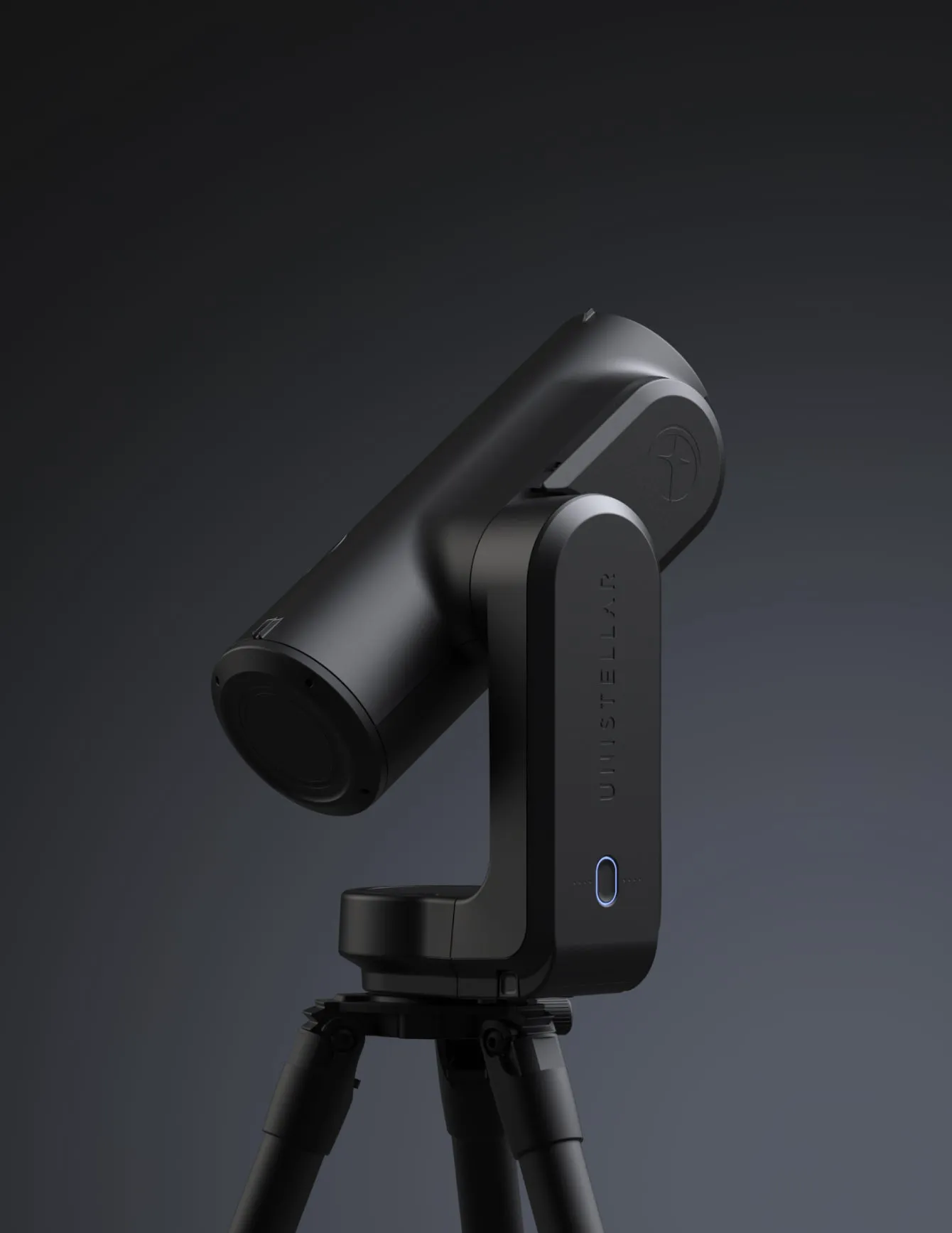
At three-quarters on its tripod, tube tilted
≈ €2,399
List price recorded in 2026, excluding promotions and accessories. It is not an offer. The price offered to you arrives in writing.
This device can be ordered from me. No basket and no online payment: the price, the lead time and availability arrive in writing. I have never had it in my hands. That is written further down this entry, and I am not going to tell you otherwise in order to sell it to you.
The device photographs are the manufacturers' official images. UST is an authorised reseller for all five brands. No image comes from a competing reseller.
not tested In this catalogue: no shots at all. Entry built on public sources.
0 · aucune donnée de première main
0 towards 165h · hours I have logged with this device, this is not a rating
For the image the l'Origin makes in 1h, it takes 2h 59m here.
This equivalence says nothing but speed. It says nothing about resolution, about the field, or about optical quality. f/2,2 on 152 mm and f/3,8 on 85 mm do not photograph the same objects. The calculation takes nothing but the published focal ratios, with sensor, sky and target held identical.
Rapport d'ouverture : the focal length divided by the diameter, written f/, and the smaller that number, the faster the image forms.
- Aperture
- 85 mm
- Focal length
- 320 mm
- Focal ratio
- f/3.8
- Sensor
- Sony 3.4 Mpx, 1.45 µm photosites (model not published by the maker)
- Resolution
- Not published in pixels: the maker only states 3.4 Mpx
- Mount
- Motorised altazimuth on two axes, with automatic pointing
- Weight
- 4 kg (6.5 kg with the tripod)
- Software
- Unistellar (iOS, Android)
- Indicative price
- ≈ €2,399
Monture azimutale : it moves in altitude and in rotation, but the field turns during the night.
The version with an eyepiece
It also exists with an eyepiece
Unistellar sells the same device under a second name, the Odyssey Pro. It is the only difference in the range, and it costs.
- The name of the version
- Unistellar Odyssey Pro
- Its price
- ≈ 4 199 €
- The difference
- 1,800 € more, that is 75% of the price of the l'Odyssey
What that changes. Nothing other than the eyepiece. Unistellar puts it in writing: “The 2 models are identical in terms of specifications, the difference being that the ODYSSEY PRO is equipped with an eyepiece.”
What this eyepiece is. A block of lenses placed in front of an OLED micro screen, and nothing more. Unistellar describes it itself as “a sophisticated lens assembly with OLED micro-display technology”, reserved for the eVscope 2 and the Odyssey Pro.
The eyepiece does not open onto the sky. It is a micro screen looked at through a block of lenses, and the image it shows comes out of the sensor, exactly like the one on the phone. No device from this brand is watched live through the glass, with or without an eyepiece.
What you pay for is comfort. 1,800 € more to put your eye to the instrument instead of looking at the phone. Not a truer image, not a deeper image: the same image, on a second screen.
Ask for a price for the Odyssey Pro version. It has no entry here, and it does not go into the comparison: the table compares only the versions without an eyepiece.
The device
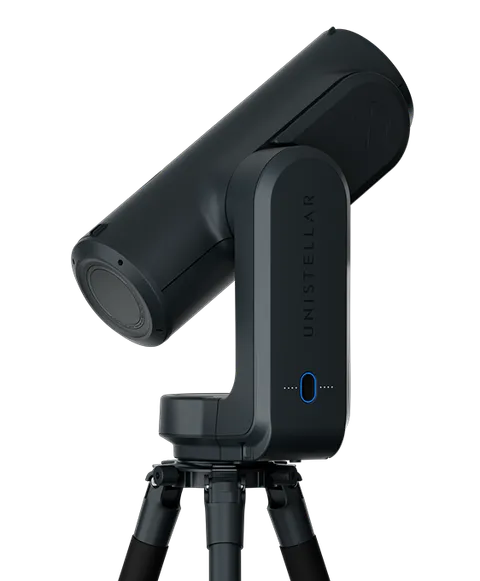
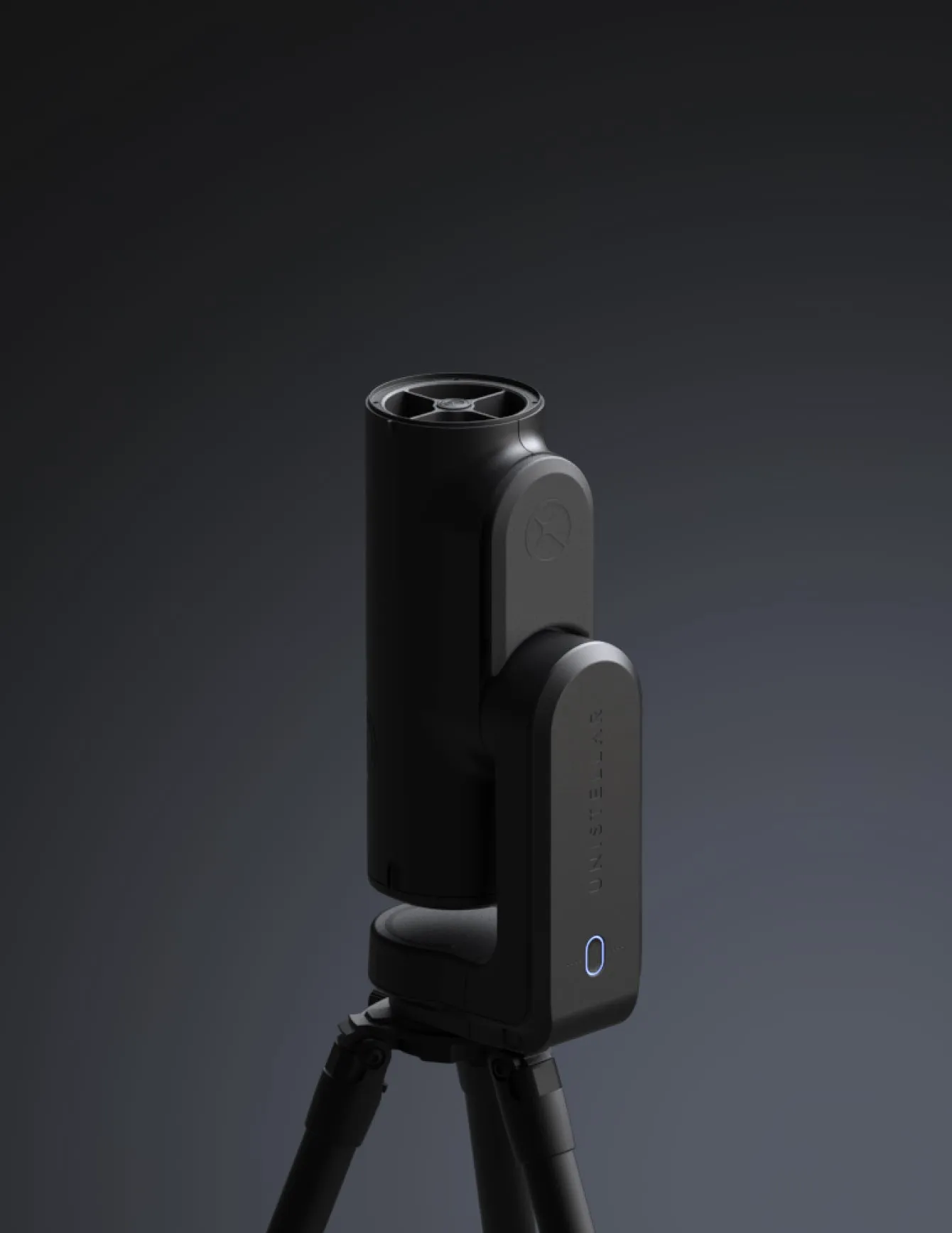
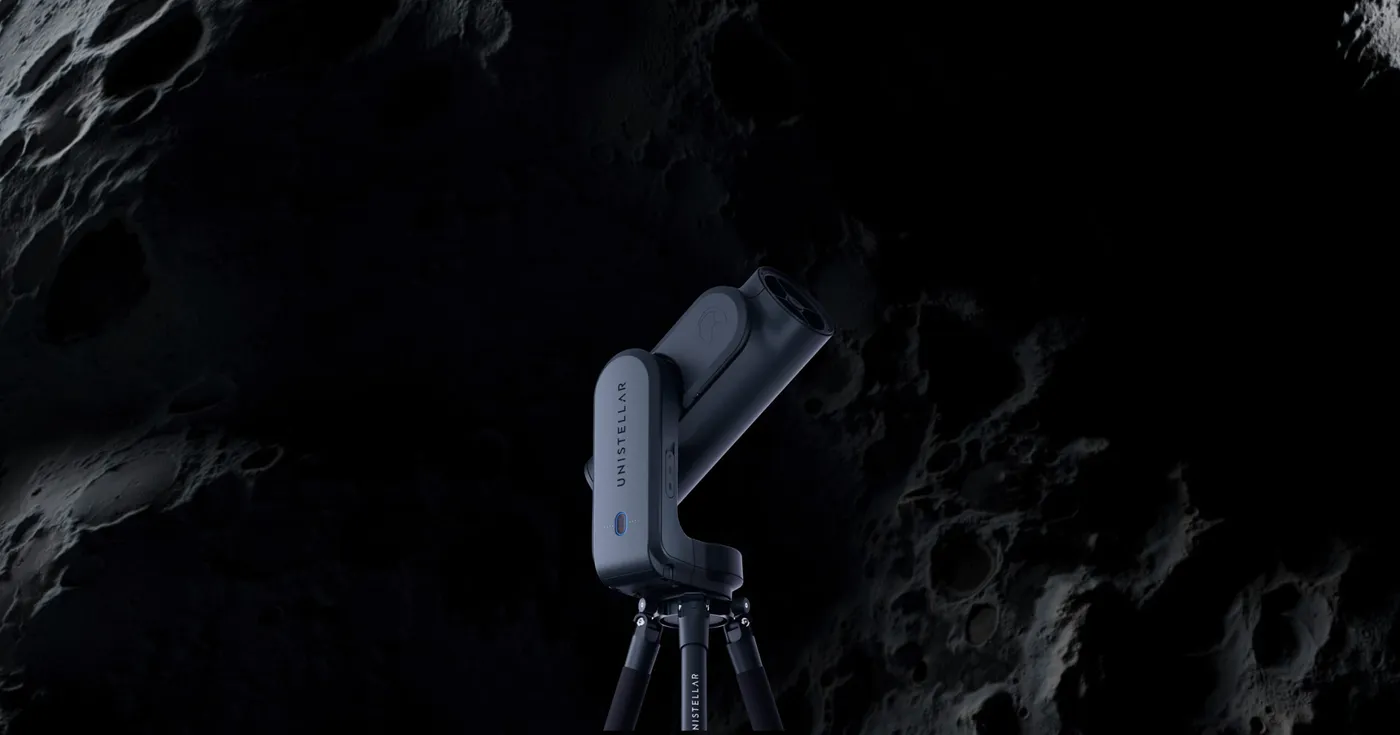
Seen from closer up
The other images published by Unistellar for this device.
Where it excels
What it does well
The deep sky from the suburbs, without the weight of the eQuinox 2. Same optical family: 85 mm instead of 114, four kilos instead of nine.
Strong points
- Four kilos of tube, against nine for the eQuinox 2. The optics are of the same family.
- After the Origin, it is the fastest device in the comparison. So it gathers the same light in less time.
- The mirrors are sealed. The optics do not drift, and no adjustment ever has to be redone.
- The device recognises the piece of sky it is aiming at on its own, in under ten seconds according to the maker.
- Quoted limiting magnitude: 17.2. The larger the number, the fainter the object. The quoted resolving power is 1.68 arcseconds.
Weak points
- The manufacturer quotes no dual-band filter. Emission nebulae will therefore ask for more exposure than a DWARF 3.
- No eyepiece. That is the stated difference from the Odyssey Pro, sold at a markedly higher price.
- Nearly five times the price of a Seestar S50 for a 3.4 megapixel sensor.
- Five hours of battery quoted. And a motor that Digital Camera World describes as slow.
- The pixel resolution of the output image is not published.
In practice
Starting out, observing, setting up

-
01
The focal ratio printed here comes from a calculation. It starts from the 85 mm and the 320 mm published by Unistellar. The manufacturer writes f/3.9, a French reseller f/3.76. The gap is down to rounding, not to the optics.
-
02
Four kilos for the tube, six and a half with the tripod. It is that second figure you carry.
-
03
The published field, what you see at one go, is 33.6 by 45 arcminutes. A little more than half a degree. The full Moon fits in it, a large nebula does not.
Images made with this device
No images: it has not been tried
This device has never been used to make one of my images. The photographs above show the device, and they come from the manufacturer. No sky image is borrowed to fill the space. Its entry rests on the published sources, listed further down. Its integration time scale therefore stays at zero.
Temps d'intégration : the total exposure time, the sum of every exposure stacked on an object.
0 images · space left empty
I publish 10 photographs, 2 of which are of equipment. None of them appears on this entry, and that is deliberate: not one of them shows this device, and an image placed there would amount to a claim.
Compare it
Head to head with another device
Each page sets the two entries line by line and works out the differences. It writes at the top which of the two was used to make my images.
Getting hold of one
Order this Odyssey
≈ €2,399
Market price recorded in 2026 from the sources cited below. It is not a selling price, and it does not constitute an offer. Your price, your lead time and availability appear in the written reply.
Say what you want to photograph, and from what sky. The answer says whether this device suits. If not, it says which one suits better. Are you looking for a second-hand one, or do you have a device to trade in? Write it in the message. The answer will be straight, including when it is no.
Sources
Where these figures come from
- Unistellar, page officielle de l'Odyssey
- Boutique européenne Unistellar, relevé de prix en euros
- Télescopes et Accessoires, fiche produit Odyssey
- Digital Camera World, test de l'Odyssey
The prices are indicative and recorded in 2026. A specification wrong or out of date? Report it. The field of view and the sampling are not published here. The physical size of the sensor is not part of the project's sourced data, and those two values cannot be estimated.
Some of these sources are the pages of resellers selling the same device as me. They stay cited: that is where the figure comes from. Removing them would make this entry impossible to check. I refuse to do that.