
DwarfLab · China
DwarfLab DWARF Mini
The smallest smart telescope on the market. 30 mm in a body of 840 g, filters included.
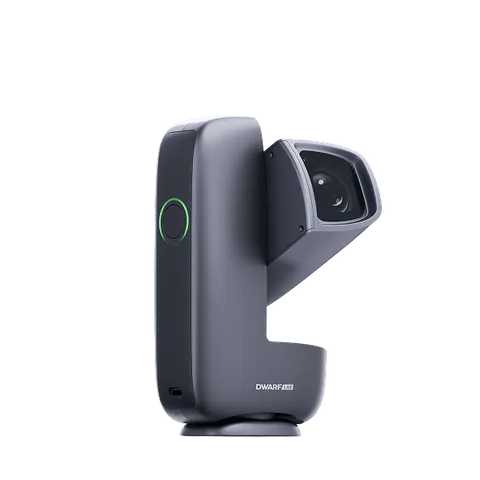
Optical arm extended, in the observing position
≈ €429
List price recorded in 2026, excluding promotions and accessories. It is not an offer. The price offered to you arrives in writing.
This device can be ordered from me. No basket and no online payment: the price, the lead time and availability arrive in writing. I have never had it in my hands. That is written further down this entry, and I am not going to tell you otherwise in order to sell it to you.
The device photographs are the manufacturers' official images. UST is an authorised reseller for all five brands. No image comes from a competing reseller.
not tested In this catalogue: no shots at all. Entry built on public sources.
0 · aucune donnée de première main
0 towards 165h · hours I have logged with this device, this is not a rating
For the image the l'Origin makes in 1h, it takes 5h 10m here.
This equivalence says nothing but speed. It says nothing about resolution, about the field, or about optical quality. f/2,2 on 152 mm and f/5 on 30 mm do not photograph the same objects. The calculation takes nothing but the published focal ratios, with sensor, sky and target held identical.
Rapport d'ouverture : the focal length divided by the diameter, written f/, and the smaller that number, the faster the image forms.
- Aperture
- 30 mm
- Focal length
- 150 mm
- Focal ratio
- f/5
- Sensor
- Sony IMX662
- Resolution
- 1,920 × 1,080 px
- Mount
- Altazimuth, tiltable into equatorial mode
- Weight
- 0.84 kg
- Software
- DWARFLAB (iOS, Android)
- Indicative price
- ≈ €429
Monture azimutale : it moves in altitude and in rotation, but the field turns during the night. Monture équatoriale : one axis set on that of the Earth, so that the field no longer turns.
The device
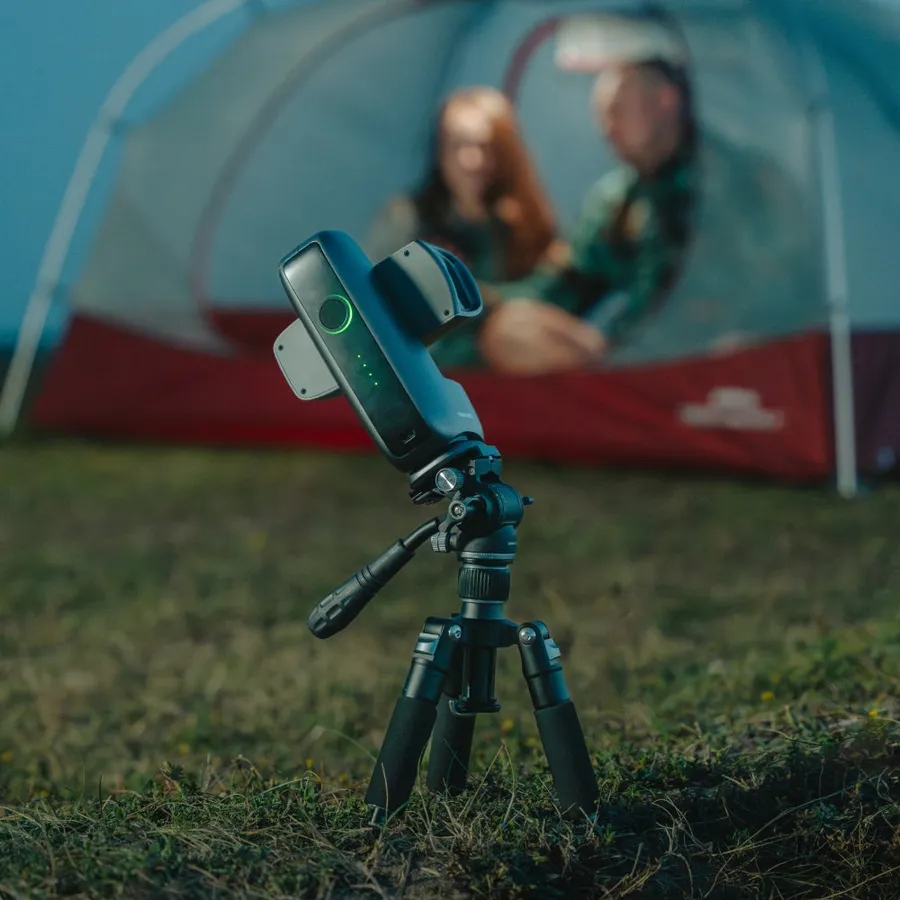
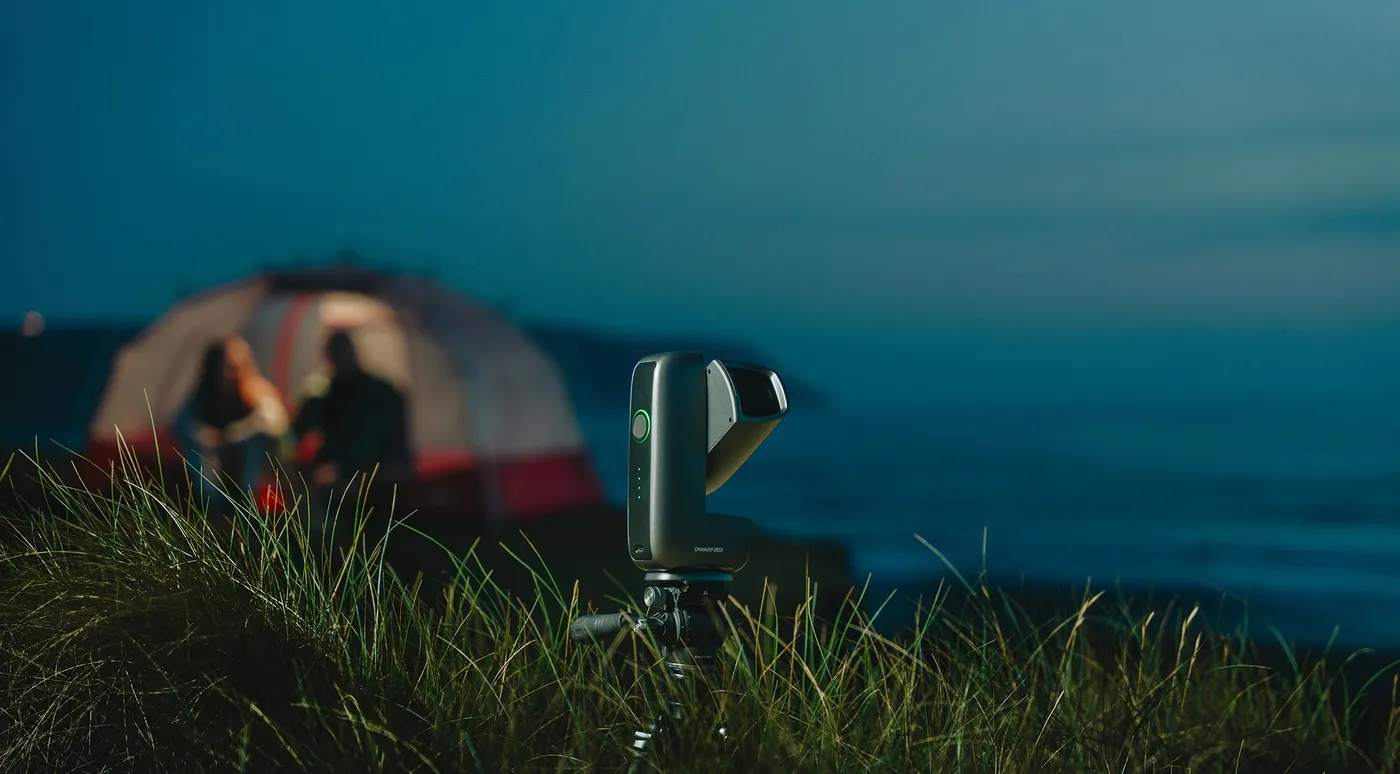
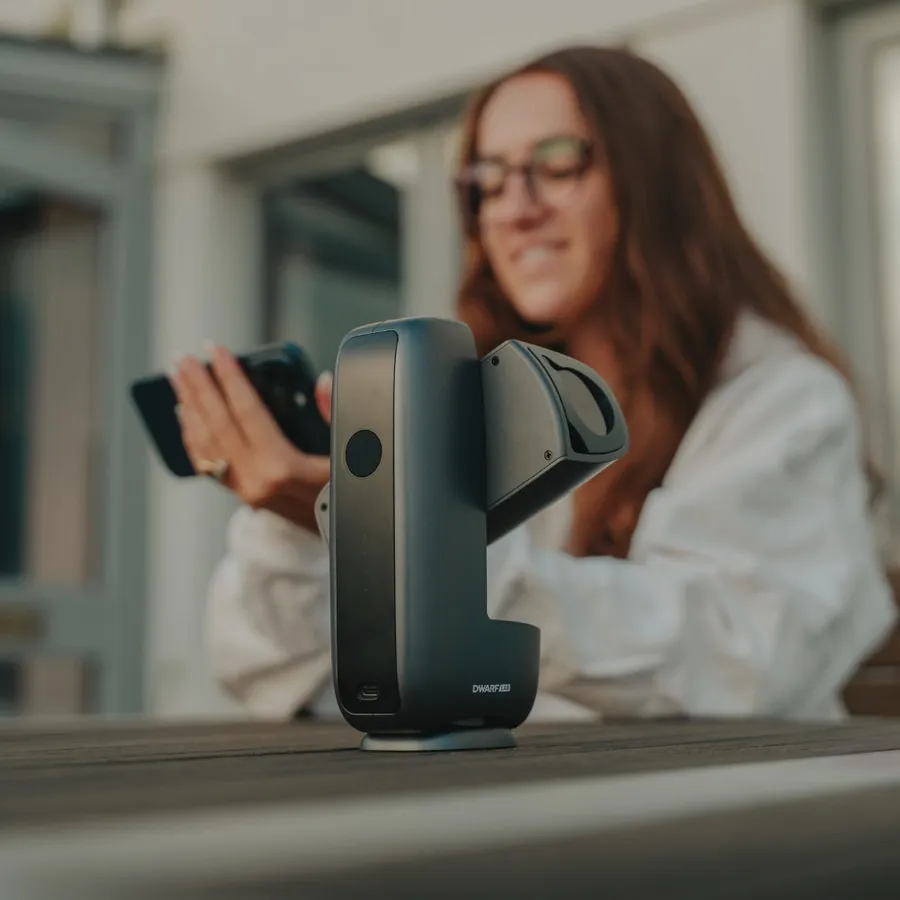
Seen from closer up
The other images published by DwarfLab for this device.
Where it excels
What it does well
The first device you buy, and the second one you take everywhere. At telephoto, it sees about 2.1° by 1.2° at one go. Enough to aim at compact objects, or at a piece of the large gas clouds.
Strong points
- The lowest entry price of the devices compared here.
- Built-in filter wheel, dual-band filter included.
- 840 g: it fits in a pocket of a camera bag.
- ED glass optics and multi-coating, despite the price. That glass scatters colours very little.
Weak points
- 2.1 Mpx only: little room to crop.
- Beyond 30 s of exposure, equatorial polar alignment becomes compulsory. That asks more of you than simply setting it down and switching it on.
- 30 mm: it is made for large objects, not for galaxies.
In practice
Starting out, observing, setting up
-
01
Best used on compact objects. The North America, the Heart and Soul or the Veil in Cygnus spill out of the frame. Aim at them piece by piece.
-
02
On an alt-azimuth mount, take many short exposures. For long exposures, switch to equatorial mode: up to 90 s per exposure.
Images made with this device
No images: it has not been tried
This device has never been used to make one of my images. The photographs above show the device, and they come from the manufacturer. No sky image is borrowed to fill the space. Its entry rests on the published sources, listed further down. Its integration time scale therefore stays at zero.
Temps d'intégration : the total exposure time, the sum of every exposure stacked on an object.
0 images · space left empty
I publish 10 photographs, 2 of which are of equipment. None of them appears on this entry, and that is deliberate: not one of them shows this device, and an image placed there would amount to a claim.
Compare it
Head to head with another device
Each page sets the two entries line by line and works out the differences. It writes at the top which of the two was used to make my images.
Getting hold of one
Order this DWARF Mini
≈ €429
Market price recorded in 2026 from the sources cited below. It is not a selling price, and it does not constitute an offer. Your price, your lead time and availability appear in the written reply.
Say what you want to photograph, and from what sky. The answer says whether this device suits. If not, it says which one suits better. Are you looking for a second-hand one, or do you have a device to trade in? Write it in the message. The answer will be straight, including when it is no.
Sources
Where these figures come from
- DWARFLAB, fiche produit
- Galactic Hunter, review DWARF Mini
- DWARFLAB, tableau de caractéristiques comparées de la gamme
The prices are indicative and recorded in 2026. A specification wrong or out of date? Report it. The field of view and the sampling are not published here. The physical size of the sensor is not part of the project's sourced data, and those two values cannot be estimated.